
What Discoveries await in the Provinces? Or: A rather unusual thesis novel
Thesis novels and utopia
Where can the kernel of the didactic nature of Na prowincji be found? Given the intensiveness of the verbalization in the novel, what comes to the fore is the message about the inadequacies of how men are being raised, with such statements emerging from all the central protagonists and then subsequently repeated throughout the novel in unison with the narrator and the authorial voice of the raisonneur. This argument is presented particularly powerfully in the assumption that Aleksander Snopiński possesses “innate talents and great vitality” albeit that his “uncommon mind” fell victim to his parents’ mistaken way of raising him (part 2, chapter I).[1] A second important argument concerns the influence of poorly chosen spouses and the education given to young women. These arguments are supported by three fiery invocations from the narrator (supported again by the raisonneur), warning against choosing a partner under the influence of “mindless instinct” and “hallucinations of the heart” (part 1, chapter VIII). They are further unlined by the physical and mental evolution of Wincunia Niemeńska (Snopińska): “her sad fate [ought to be] a mirror of the fate of thousands of others” (part 2, chapter X). The case of Aleksander, meanwhile, offers something of an a posteriori illustration of the relevant argument, while in Wincunia’s case, her fate is foretold a priori in the narrative and develops before the very eyes of the reader, thus lending the somewhat predictable plot an attractive degree of tension. The fates of these two protagonists, who carry the ethical-educational tendencies of the thesis novel, create symmetrical and intersecting counterpoints that could be depicted visually as follows:
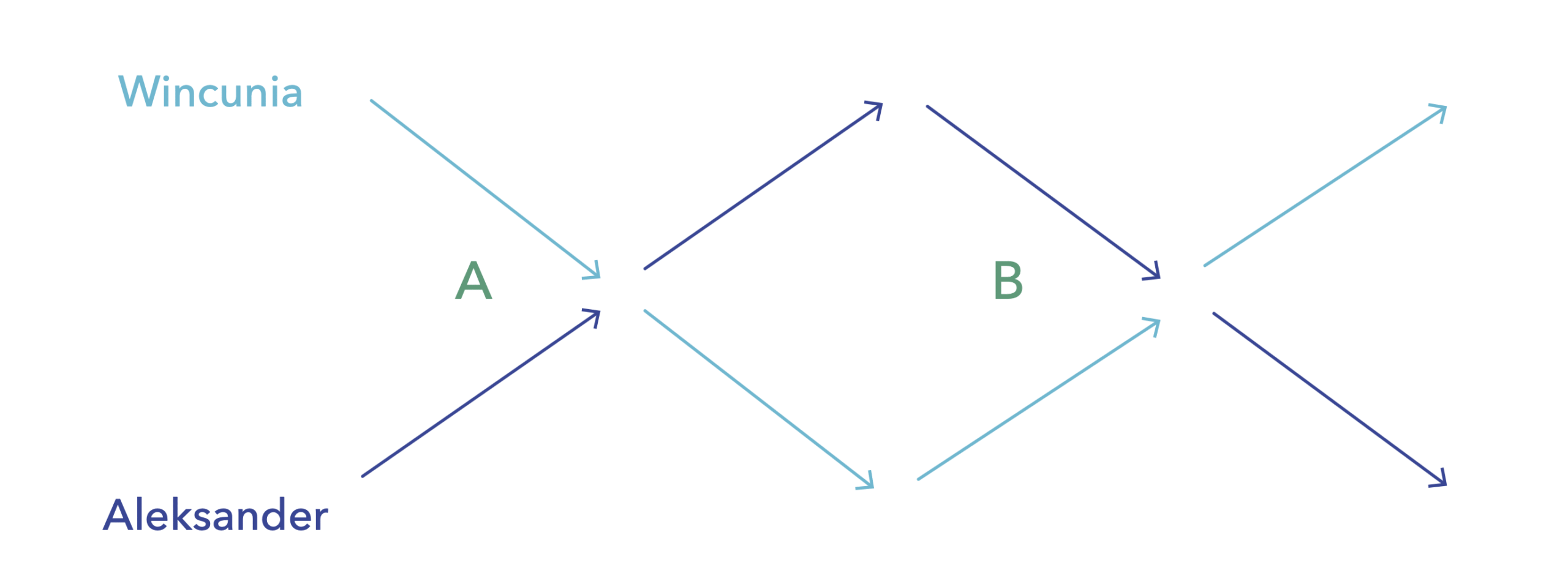
Starting from a privileged position, Wincunia, who was raised by Bolesław, wastes all the educational capital at her disposal as she plummets the depths in pursuit of the “hallucination” and sensual desires. She experiences the collapse of her marriage, family, and role as a mother before maturing and undergoing a process of self-discovery while learning the true values of life. The neglected and vain only child Aleksander, someone guided not only by self-interest but also by sincere feelings, is given a chance to develop by establishing a life alongside a valuable partner. Yet he proves incapable of making the most of the opportunity thus he inevitably returns to where he began, just like Wincunia, albeit on a level diametrically opposed to hers. Their paths cross on only two occasions – at the point where they fall passionately in love (A) and the point where they experience painful disappointment (B). The illustration of the somewhat obviously pedagogical argument creates the only convincing and, in many respects, feasible (because of its psychological, social, and everyday realism) image of reality in Na prowincji, i.e. one that lacks a happy ending, offering a rather downbeat assessment that stands in contrast to the utopian Positivist argument.
The latter argument, even if it is treated in a rather irritatingly naïve and schematic manner, remains present in the background. Still, it is only in third place in the ranking of the tendencies generating the novel’s persuasiveness. The role of social ideology is indeed crucial: it is responsible for generating the status of the model character Bolesław Topolski while ensuring that there is a counterweight to the Romantic plot line, all in accordance with the idea of a “sensible” marriage. Yet the resonance of the Positivist programme is weaker in Na prowincji than in other works from the same era. Firstly, the novel anticipates trends and slogans from the era, projecting them back onto earlier years, rather than depicting Positivist ideas in the strict sense. Bolesław and Andrzej are more pioneers of an activist programme than fulfillers of established ideas. The pre-Positivist utopias of averagely wealthy smallholdings owned by the nobility, namely Niemenka and Topolin, present a model of ideal harmony between the inhabitants of the estates and the villagers, with their surroundings, the environment and with modernity. At the same time, these locations are reflections of desired socio-economic models, something that creates associations with Ignacy Krasiński’s Mikołaja Doświadczyńskiego przypadki [English translation: The Adventures of Mr. Nicholas Wisdom] as part of the tradition of Biedermeier patriarchal landowning idylls and classical tropes of bucolic tales.[2] What is in clear evidence here is the Rousseauian Enlightenment mindset. Secondly, the depiction of provinces undergoing modernization is suspiciously and overbearingly optimistic. We are shown a rural and small-town Arcadia inhabited by an “upstanding” parish priest, a “beloved countess” (Orzeszkowa was particularly concerned to ensure that wealthy female landowners were presented in a positive light), a “prudent and educated” innkeeper, a merciful official, a dedicated doctor, peasant farmers who willingly accept the challenge of organic work, and the local saviour, Bolesław, who keeps watch over everything while implementing innovations in agriculture, industry, health and education. This idyllic image inspired protests from literary critics from the outset as they took a critical stance towards the “economic miracles” occurring in the district of X.[3] What was the reason for this regression, at least when measured again the more realistic depiction of efforts towards developing organic work in W klatce? Again, we might suspect that the depiction in the novel of wonderful developments encompassing the region fulfils the author’s own compensatory-consolatory dreams, since her text contradicts her real-life experiences.[4] Ultimately, then – and this is the third point – the world depicted in Na prowincji is marked by a blurred ontological status. Echoes of the landowning idyll that existed before the catastrophe of 1863/64 overlap with the prospective Positivist utopia. Orzeszkowa’s third novel features not only partial Mickiewiczian stylizations, a longstanding feature of literary analyses[5], yet as a whole it does form something of a Mickiewiczian reckoning with the “remnants” of the time preceding the January Uprising. It both bids farewell to and pays homage to the landowning Arcadia that is retreating into the mists of time. The elegiac bucolic ideal inscribed in the work (beautiful depictions of nature, Hesiodian rhythms of labour and daily routines) is marked by a biographical subtext[6]. Na prowincji anticipates her later writings where the organic utopians, while uncertain of the effects of their efforts, nevertheless see the rural provinces as the only shelter offering protection against the evils of the city, civilization, and the world.
Przypisy
- This message is communicated for the final time in the novel by the female protagonist on her death bed: “he will die sullied by a life lived under the finger of God, who has punished him for the sin committed against him by his parents” (part 2, chapter XI). Orzeszkowa did not, of course, pioneer such critiques, with Józef Dzierzkowski, for example (in the novels Dla posagu [For the Dowry; 1847] and Serce kobiece [A Woman’s Heart; 1858]), presenting quite suggestively similar arguments regarding the consequences of a lack of a good upbringing for landowners’ sons.
- The agrarian utopia in Na prowincji is strikingly similar to the ideally managed Polesian estate of the Hutor-Graba family that appears in Kraszewski’s educational morality novel Dziwadła [The Oddities; 1853], a work that is actually referred to in the novel (see part 2, chapter IV). The title of Kraszewski’s novel of course refers to positive progressive, democratic and idealist figures.
- M. Żmigrodzka, Orzeszkowa. Młodość pozytywizmu, Warszawa 1965, p. 406. “Strange miracles occur (in) Na prowincji. A genuine Arcadia emerges there” (A. Drogoszewski, Eliza Orzeszkowa, p. XLIII). A rather humorous indicator of the naivety of this image are the references to various undefined factories.
- “May God allow me to escape as soon as possible this veritable valley of tears, these here provinces”; “I would like to emancipate myself once and for all from the problems I face here and the company I keep here, which is as boring as… this spring is intolerable… as is the vast majority of a human existence”; “Oh, why do the wealthy people of our province so rarely understand the great power of influence and propaganda that lies in their hands!”; “to live in Warsaw, that is my dream” – these were all complaints made by Orzeszkowa between 1867 and 1870 (letter to J. Sikorski, dated 7 (19) March 1867, Lz 1, p. 4; letter to J. Sikorski from 1867, Lz 1, pp. 8–9; letter to J. Sikorski from January-February 1869, Lz 1, p. 47; letter to J.K. Gregorowicz dated 22 October 1870, Lz 8, p. 10).
- See: M. Żmigrodzka, Orzeszkowa…, p. 375; B. Noworolska, Eliza Orzeszkowa: trwanie, pamięć, historia, p. 43 ff.; A. Narolska, Przestrzeń “upodrzędniona”…, pp. 88–93. As Iwona Wiśniewska has noted, even Orzeszkowa’s column pieces combined “an idyllic landowning Arcadia with the Positivist civilizational Arcadia” (Wiśniewska, Zakątki Wielkiego Księstwa Litewskiego we wczesnych felietonach Elizy Orzeszkowej, p. 239).
- “I will certainly be sad to leave behind my family home with the shady paths running through my garden and the broad view of the meadows”; “I am sad to be leaving the village whose peacefulness harmonizes with my current mood” (letters to J. Sikorski dated 7 (19) March 1867 and 12 (24) November 1869, Lz 1, pp. 4, 58). One telling passage in the novel is: “And it was quiet in the rural retreat, as if it had been embraced by the wings of an angel, separating it off from the noise and troubles of the world, as if God Himself had touched it with his blessed finger, covering the shelter of hardworking people in peace and beauty” (part 1, chapter VIII).